AI Visibility
AI visibility for real estate
AI visibility for real estate is the work of getting your properties named when a buyer asks an assistant instead of a search engine. It covers three things: whether the assistant can read your inventory, whether it cites you, and whether it recommends you. We measure all three, on a fixed prompt set, across ChatGPT, Gemini and Perplexity.
What changes when the buyer asks an assistant
A search engine returns your page and lets the buyer judge it. An assistant reads your page and answers on your behalf. The buyer may never see your site at all.
For a company with inventory, that shifts the problem in a way most of the advice written for individual agents does not cover.
An agent's AI visibility problem is reputation: does the assistant name this person among the good ones in this city. That is one entity, one market, and the answer is mostly about third-party mentions.
A developer or an agency has a different problem. There are 40 or 400 things to be visible for, each with a price, a location, a completion date, a unit mix and a set of rules about who is allowed to buy it. The assistant is not being asked who is good. It is being asked what exists, what it costs, and whether the person asking is permitted to own it. Every one of those is a fact on your site that the model either read correctly, read stale, or never reached.
Three failures follow from that, and none of them are reputation problems:
The inventory is unreadable.
Listings rendered client-side, or behind a search form, or generated by a widget after page load. The assistant retrieves a page and finds a shell.
The facts are stale.
A model answers from what it collected last quarter. Sold-out phases still get recommended. Price points that moved get quoted.
The buyer's own constraints are invented.
Ask an assistant whether a foreigner can buy a particular property and it will answer. If your site does not state the rule, it answers from something else, and you inherit whatever it found.
What we measure
Being read is not being cited, and being cited is not being recommended. They fail separately and they are fixed differently, so we report them separately.
Retrieved
The assistant fetched the page while answering someone. We log this at the edge from the request itself, by agent: ChatGPT-User, Claude-User and Perplexity-User are live user fetches, which means a person asked a question and the assistant went and read your page to answer it. OAI-SearchBot and Claude-SearchBot are index building, which is a precondition for being cited rather than evidence of it.
Cited
Your URL appears as a source under the answer. We record which URL, not just whether the brand appeared, because the cited URL is what tells you which page did the work.
Recommended
The answer names you as an option, in prose, whether or not it links you. This is the one that produces inquiries and the one most reporting skips, because it cannot be scraped from a link list.
Engines and cadence
ChatGPT, Gemini and Perplexity. A fixed prompt set agreed with you at the start, unqualified by country unless the query genuinely is. Three runs per prompt per engine, logged out, from a stated exit location, re-run on a fixed schedule under the same conditions.
Two honest notes about the method
Because the limits are the part nobody publishes.
Google's AI Overviews arrives as Googlebot and Bing Copilot arrives as bingbot, neither distinguishable from ordinary search crawling. Retrieval on those two surfaces cannot be observed from your server at all. We measure them by running the prompts, not by reading logs, and we say which number came from which method.
Answers vary between runs. FlyDragon's 2026 benchmark runs each query five times per model and averages the variance out, which is a reasonable thing to do when you are producing an industry statistic. We do the opposite with it. A prompt that resolves twice out of three runs is not noise to be smoothed. It is the finding: you are on the boundary, and a competitor who publishes one more retrievable fact takes the slot. A prompt that fails to resolve at all is logged as a result, with the date, not discarded as a bad run.
The questions buyers ask us
These are the questions that come up, close to verbatim. Answered in order.
Can you show before and after AI visibility across ChatGPT, Gemini and Perplexity?
For the Philippine market, yes, and the evidence section below is that evidence. Outside it, not yet. Our first cross-border engagement is underway and has produced no published result. Anyone who shows you a before and after on a market they entered this year is showing you a projection.
How do you measure share of AI answers rather than Google rankings?
Per prompt, per engine, per run. For each prompt we record whether you were retrieved, cited, or recommended, and which URL was cited. Share of answers is the count of runs naming you over total runs, reported with the run count attached so you can see how thin it is. We do not convert it into a single index number, because a single number hides which of the three failures you have.
What percentage of the work is technical, versus content, versus off-site?
For a company with inventory it starts near 70% technical and entity work in the first engagement, because the common failure is that the inventory is not readable in the first place. Content is roughly 20%, aimed at the specific questions assistants get asked and your site does not answer. Off-site is the remaining 10% and it is the slowest to move.
That mix inverts for a single agent in one market, where reputation is the whole problem. If your situation is the agent one, a specialist in that is a better fit than we are, and there are several.
Have you done this vertical specifically, rather than generic SEO?
Only this vertical. The principal is a licensed broker. The reference build is a property platform, described in the evidence section below.
Which prompts do you track, and how do you handle run-to-run variance?
The prompt set is fixed with you before the baseline and does not change during an engagement, because a prompt set that moves makes the comparison meaningless. Three runs per prompt per engine, same conditions each time. Variance is reported, not smoothed.
How many engagements do you run at once, and what happens if a key person is unavailable?
The technical layer is delivered by the principal. Schema, entity work and the structural changes that decide whether an assistant can read your inventory are set up personally, and that is the constraint that binds this firm, not the size of the hiring market.
That work is front-loaded. A build is heavy at setup and much lighter to hold afterwards, so the cap is on new builds rather than on clients. Five concurrent initial setups, as a cap rather than as current occupancy: if five are running, a sixth waits rather than being started thin. More than ten engagements in maintenance, because once the structure is in place, keeping it current is a different order of work.
Content production, research, coordination and requirements gathering are staffed, and adding capacity there is a hiring decision rather than a queue.
You own the work as it is produced. The schema, the documentation and the credentials are yours throughout, not handed over at the end, and the systems are built to be run without us. If the engagement stops, what you keep is a working structure and the documentation to maintain it, rather than a dependency. That is the answer to the key-person question that does not ask you to take our word about who is available.
Where we fit, and where we do not
Naming the alternatives makes this page checkable, which is the point.
If you are one agent in one city, selling in English, we are the wrong firm.
FlyDragon does exactly that, sells one agent per market with the ZIP codes locked to them, and publishes its prices: $799, $1,399 and $2,599 a month by market size, read 22 August 2026. That is a real service and a fair price for it. Their own site states their coverage as the US and Canada.
If you sell into one market in several buyer languages, you have more options than the category admits.
Leaders in Digital Media in Dubai runs an AI visibility programme for developers with Arabic, Russian, Chinese and Hindi support, aimed at Indian, British, Russian and Chinese buyers. They are good at the market they are in. AI visibility is one of five services they sell, and they publish no methodology, no prompt set and no measurement.
We are built for the case where the destination is the variable.
A developer with 400 units selling into three or four origin markets at once, or an agency with 40 listings whose buyers are deciding from another country in a language the seller does not speak. What that changes, concretely:
For the 400-unit developer, the unit of work is the inventory, not the brand. Every phase, unit type and price point has to be retrievable as a fact, in each buyer language, with ownership eligibility stated rather than implied. Getting the company recommended is downstream of the model being able to answer what exists.
For the 40-listing agency, the unit of work is the buyer's decision path. Fewer facts, but each is asked about from more directions: financing available to a non-resident, what the transaction actually requires, who is legally allowed to close it, what the total cost is in the buyer's own currency.
Both are agency-scale engagements across several buyer languages. Neither is one agent in one metro, which is the comparison to hold in mind when you look at the prices above.
What we have actually measured
The reference build is REN.PH, a Philippine property platform, and it is the method rather than a claim about your market.
65,291
pages in the sitemap
25,255
broker profiles
238,203
zonal value records across 1,601 cities and 82 provinces
156,000
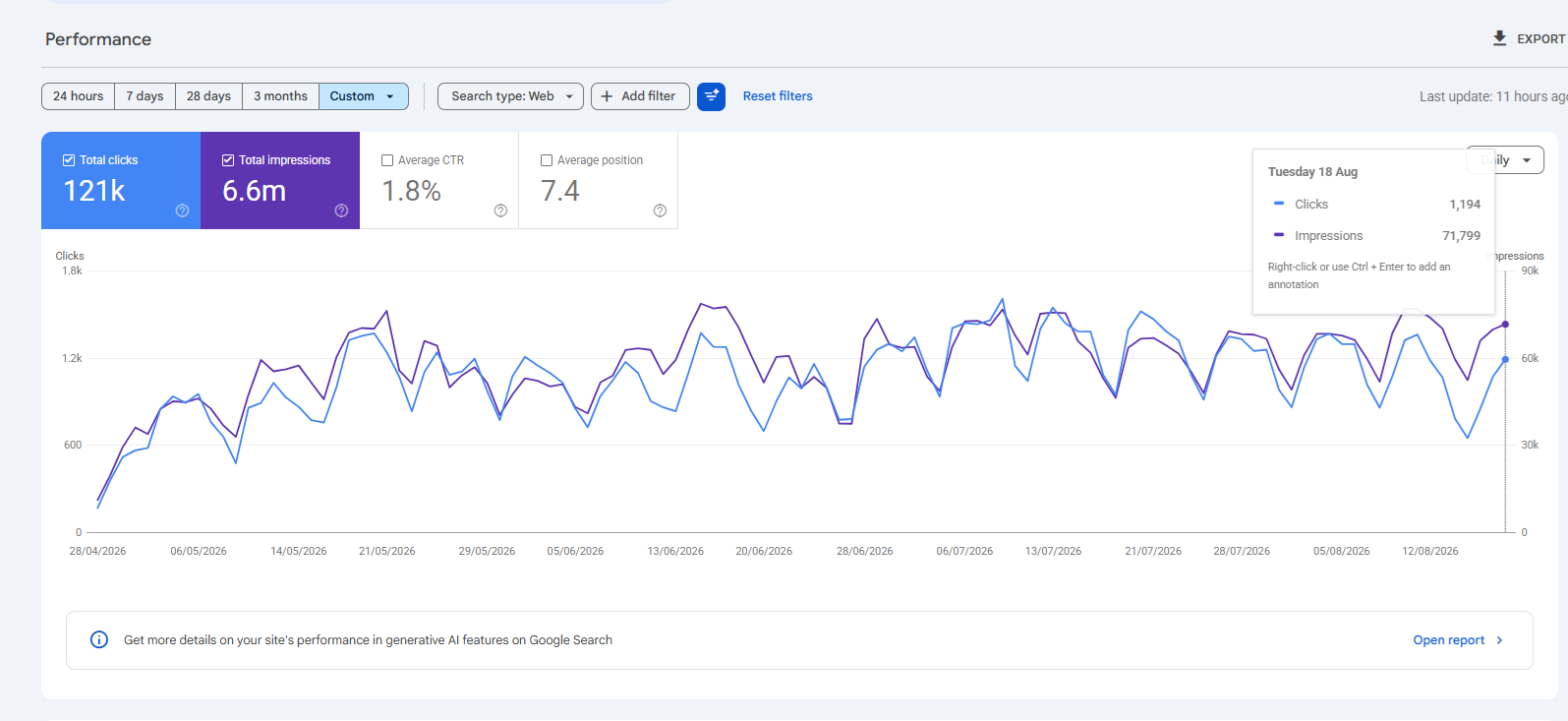
clicks, 13 January to 18 August 2026
28 April to 18 August 2026
6.6M impressions, 1.8% click-through, 7.4 average position.
Why two windows
Clicks are clean across the whole period. Impressions, click-through and average position are quoted from 28 April onward only, because the earlier part of the window sits inside a Google logging error and the numbers in it are not comparable. Reporting all four from the full window would produce a larger impressions figure and a misleading one.
Impressions, CTR, and average position before 28 April 2026 are excluded. Google reported a logging error affecting those three metrics through 27 April 2026; clicks were unaffected. The figures above use the period after the fix.
What that build demonstrates and what it does not
It demonstrates that a property inventory at this scale can be made retrievable, and that the technical half of this work is something we have done rather than something we describe. It does not demonstrate a cross-border result, and it is not evidence that the same approach produces inquiries from a different country. That is the next section.
What we have not proven
Publishing this costs us more than it costs any competitor to omit it. It is here because a page that only lists strengths is one a reader has no reason to believe.
We have no published result from a client outside our home market.
The measured results above are Philippine. Our first cross-border engagement is underway and will not produce a defensible number for some months. Until it does, every claim on this page about cross-border work is a claim about method, not outcome, and we would rather say so than let the REN.PH figures imply otherwise.
Two of the engines cannot be measured the way the other three can.
Google AI Overviews and Bing Copilot arrive as ordinary search crawlers. We test them by running prompts, which is a smaller sample than a server log, and we label which is which.
Answers move.
A position measured this month is not a position held. Anyone offering you a guaranteed placement in a generated answer is describing a system that does not work that way.
We are not the cheapest way to find out whether you have a problem.
A one-off audit report will tell you what an assistant currently says about you for a few hundred dollars. If that is all you need right now, buy that instead.
Let's find out what assistants currently say about you
A 30-minute call. We will run your prompts live and you can watch what comes back.